How do people find their way into the Salesforce ecosystem?
For Kristyna Turner, the answer is anything but straightforward.
A Salesforce MVP with more than 14 years of experience across CRM, marketing technology, and digital transformation, Kriss has worked with global companies including Pfizer, Novartis, Daimler/Mercedes, and Stellantis.
Kriss is also a community leader, co-leads the Salesforce Marketing User Group in Sydney, and co-founded CzechDreamin, one of the Salesforce community’s largest volunteer-run events.
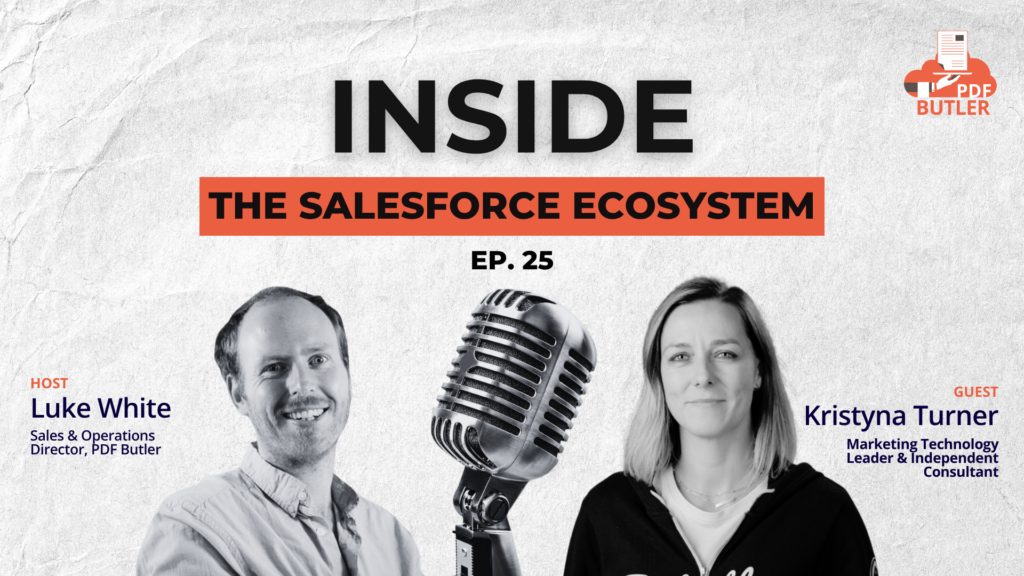
In Episode 25 of Inside the Salesforce Ecosystem, Kriss joined Luke to talk about her unconventional career, the Salesforce community, lessons from large-scale digital transformations, the future of AI and agents, and more.
A career that doesn’t fit in one box
Kriss began her career with a master’s degree in environmental engineering before moving into marketing and sales. When Luke asked her to introduce herself, she admitted that it is a difficult question to answer.
As she put it, “my career has never been really fitted neatly into one box.”
Her first experience with Salesforce came from the customer side. While working for an education provider in Sydney, she saw the company roll out Salesforce to a team that was not particularly enthusiastic about adopting it.
Rather than simply accepting the resistance, Kriss taught herself how the platform worked and helped her colleagues understand how to use it effectively.
That experience later became valuable when she moved into consulting. Having been a Salesforce user herself, she understood what it felt like to be on the receiving end of a technology implementation.
That customer perspective continues to shape how she approaches transformation projects today.
Why the Salesforce community matters
When asked what has kept her in the Salesforce ecosystem, Kriss’ answer comes down to one thing: the people.
She is a passionate Salesforce community leader and co-leads the Salesforce Marketing User Group in Sydney. Over the years, she has also built close friendships through Salesforce events and community groups.
Her Salesforce MVP recognition meant a lot to her, but not simply because of the title.
For her, the real value lies in the community itself.
As she explained, “The community is the part of the ecosystem that Salesforce cannot manufacture.”
Building CzechDreamin
Kriss’ involvement with CzechDreamin started almost by accident.
Her boss at the time, who founded the event, mentioned his idea of bringing the Czech and Slovak Salesforce community together with the wider international ecosystem. Kriss offered to help without knowing quite what she was getting herself into.
Nine years later, CzechDreamin has grown into one of the largest volunteer-run Salesforce community events, attracting around 450 attendees.
But running an event of that size is not easy.
Every year, the team essentially rebuilds the event from the ground up, managing sponsors, budgets, marketing, logistics, speakers, and everything in between.
Sponsors play an important role, but for Kriss, the real reward comes when the event finally happens and hundreds of people start connecting with each other.
And there may be something new on the horizon. Kriss hinted at a bigger idea for next year involving Dreamin’ in Data too.
We’ll leave the spoilers to her.
The biggest lesson from large-scale Salesforce transformations
After working on huge programs across multiple countries, Kriss has a clear takeaway: “Technology is rarely the hardest part of the transformation.”
The harder questions are about people. Who owns the process? Who makes the decisions? Are the markets aligned? Are people ready to change how they’ve worked for years?
She has even audited projects where clients blamed the technology, only to find the processes needed to change. She noted that “no one likes to hear that.”
Luke added that getting real buy in from end users can make or break a project, and Kriss’ advice is to adapt your message. Upper management and users care about different things, so you need to be “like a chameleon.”
3 common Salesforce implementation mistakes
Kriss shared the three mistakes she sees most often:
1. Treating Salesforce as an IT project.
In her words, “Salesforce is a business platform.” Every department that will use it needs to be involved from the start, not waiting to receive it.
When business teams are brought in too late, organizations risk building solutions that technically work but do not solve the problems users actually have.
2. Automating bad processes.
Automation can make a good process faster. It can also make a bad process faster.
Her rule is simple: “I would always simplify before I automate.”
Before introducing automation, teams should understand the existing process, remove unnecessary steps, and make sure the desired outcome is clear. Only then does it make sense to automate.
3. Measuring success by going live.
Launching a Salesforce project on time and within budget is an achievement, but Kriss believes it should not be the final measure of success.
The more important questions come afterwards:
- Are people actually using the system?
- Are they using it correctly?
- Has the customer experience improved?
- Has sales productivity improved?
- Is the organization making better decisions?
A successful go-live is a milestone. It is not necessarily the end goal.
Advice for people starting their Salesforce careers
For anyone new to the Salesforce ecosystem, Kriss’ first piece of advice is simple: get involved in the community.
The community helped her build skills, make connections, and learn from people working in different roles and companies.
Certifications can certainly help, but she does not see them as the most important part of building a Salesforce career.
Real-world experience matters.
Her advice is to get “a real-life project, hands-on experience and to see how it works in real time.”
Trailhead is a valuable learning resource, but real projects involve real people, competing priorities, unexpected problems, and organizational change.
As Kriss knows from experience, those things rarely behave exactly as they do on paper.
Where to find Kriss next
Kriss will be speaking at Salesforce community events in Australia, including True Blue Blazing in Melbourne in October and Down Under in Brisbane in November. And, of course, there is CzechDreamin to look forward to next year in May.
Thanks to Kriss for a thoughtful, honest, and often funny conversation. Her career is a great reminder that there is no single path into the Salesforce ecosystem and that real-world experience, community, and curiosity can take you in unexpected directions.
If you work with Salesforce, digital transformation, or AI, listen to Episode 25 of Inside the Salesforce Ecosystem to hear the full conversation with Kriss Turner.