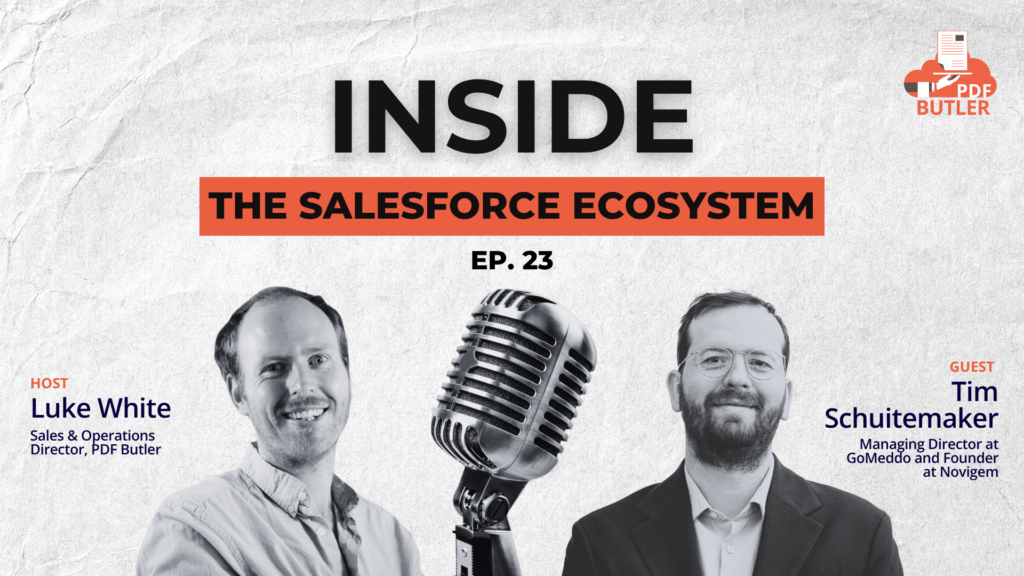
After nearly 15 years in the Salesforce ecosystem, Tim Schuitemaker has worn many hats: consultant, engineer, founder, and product builder.
Today, he is the Managing Director at GoMeddo, an award-winning Salesforce-native scheduling platform, while also launching his latest venture, Novigem, a gamification app designed to improve Salesforce adoption.
In Episode 23 of Inside the Salesforce Ecosystem, Luke sits down with Tim to discuss what it takes to build successful Salesforce-native applications, how the ecosystem has evolved over the years, and why changing user behavior may be the biggest challenge facing CRM teams today.
From Consultant to Multi-Product Founder
Like many Salesforce founders, Tim’s journey started in consulting.
Working closely with customers for years allowed him to recognize recurring challenges, particularly around scheduling, which eventually led to the creation of GoMeddo.
Rather than simply solving appointment booking, GoMeddo tackles complex scheduling scenarios involving multiple people, rooms, resources, and business rules. Whether it’s coordinating healthcare appointments or managing student housing, the platform is built to solve scheduling problems that standard tools simply can’t handle.
Why Build Natively on Salesforce?
One of the biggest themes of the episode is the value of building directly on the Salesforce platform.
Tim explains that Salesforce-native applications inherit much of what customers already need:
- Existing data models
- Built-in security
- Identity management
- Standard reporting and dashboards
- No additional logins or data synchronization
At the same time, native development comes with its own challenges. ISVs must design around governor limits, multi-tenant architecture, and Salesforce’s security review process, constraints that ultimately encourage smarter product design.
He also points out that building on Salesforce means embracing its constraints rather than fighting them.
“You design around this whole subset of limits. It’s not a blank canvas where you can just start.”
The Real Problem Isn’t Data, It’s Behavior
Instead of simply measuring sales performance, Novigem focuses on something many organizations struggle with: getting users to consistently maintain high-quality CRM data.
Novigem was built to solve a problem Tim had seen throughout his entire career.
“People forget… They’re in a call, they need to hurry to the next call… They need to write this note inside of the system… What you have is a team that doesn’t log their activities or that doesn’t update their pipeline.”
Rather than forcing compliance through required fields, Novigem uses gamification, coaching, and positive reinforcement to encourage the right behaviors.
The early pilot results have been encouraging, with customers seeing significant improvements in user adoption and data quality after introducing the platform.
AI Won’t Replace Good Habits
Tim believes AI is changing how Salesforce users work, from automatically logging activities to summarizing customer interactions. But even the smartest AI relies on quality data.
AI may be transforming Salesforce, but Tim believes success still depends on high-quality user behavior.
His view is simple: AI can automate tasks, but organizations still need to encourage the right behaviors that keep Salesforce data accurate and complete.
It’s a perspective that shifts the conversation from “How can AI do more?” to “How can AI help people work better?”
Advice for Aspiring Salesforce ISVs
For anyone thinking about launching their own Salesforce application, Tim shares practical advice learned from years of experience.
His advice for first-time founders is refreshingly practical.
“Find the problem, find the pain that someone is experiencing, and build it narrowly.”
His recommendations include:
- Solve one specific customer problem well.
- Talk to admins and end users, not just buyers.
- Design with Salesforce’s platform limits in mind.
- Don’t wait forever to launch. Ship early and improve through feedback.
This or That
Luke wrapped up the episode with a quick-fire round:
- Startup life or corporate life? → Start up, used to be corporate.
- Close a new customer or build a new feature? → Close a new customer!
- Salesforce World Tour or Community Event? → For GoMeddo World Tour, for Novigem, community event.
- Product roadmap or Customer feedback? → Always customer feedback. Customer feedback is what drives the road map.
- Founder mode or manager mode? → Founder mode.
Listen to the Full Episode
Whether you’re building your first AppExchange product, leading a Salesforce implementation, or simply curious about how successful ISVs think about product development, this episode offers valuable insights from someone who has spent over a decade building on the platform.
Tune in to Episode 23 of Inside the Salesforce Ecosystem to hear the full conversation with Tim Schuitemaker and discover why solving user behavior (not just technical problems) might be the next big opportunity in Salesforce.