What does it really take to get value from a Salesforce investment?
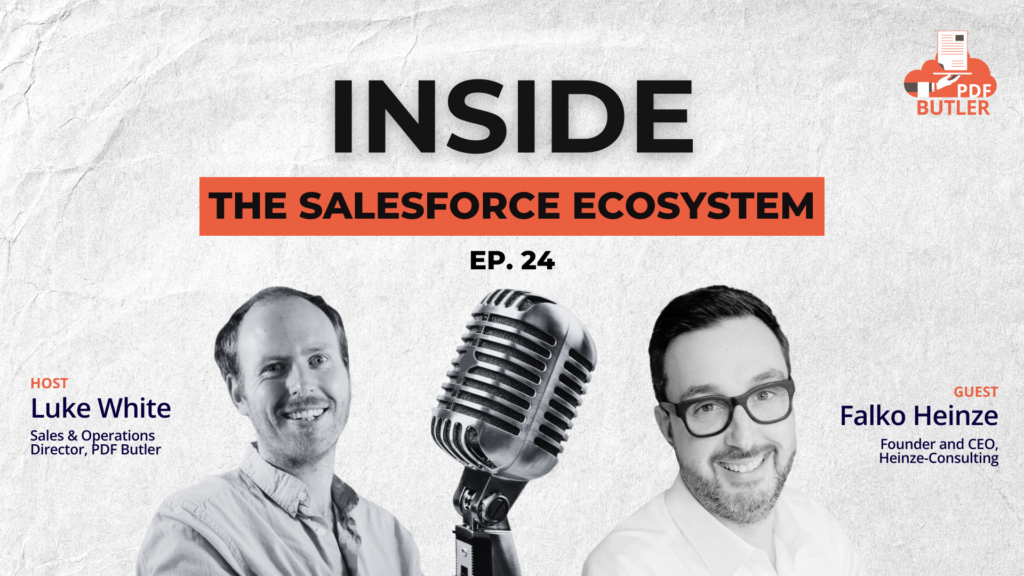
In Episode 24 of Inside the Salesforce Ecosystem, we sit down with Falko Heinze, a former Salesforce leader with more than 11 years of experience at Salesforce and now the founder of Heinze Consulting.
After spending more than a decade on the Salesforce side, Falko made the move to independent consulting, helping organizations get more value from their Salesforce investments through contract and licensing strategy, negotiation support, and adoption-driven optimization.
In this conversation, we explore what he learned from his time at Salesforce, why customers sometimes struggle to get the ROI they expect, the growing importance of ISVs and consulting partners, and how rapid innovation is changing the Salesforce ecosystem.
Falko’s Journey into the Salesforce Ecosystem
Falko’s path into tech started in Germany. “I spent over 20 years in IT, most of the time with software vendors in different shapes (ERP systems, retail, online trading) Almost 15 years ago, in 2011, I was asked by Salesforce to join them.”
He started as a success architect, back when it wasn’t yet branded as “customer success.” It was simply about giving customers real value from what they’d bought.
In 2023, he switched sides and founded his own consultancy.
“I want to sit on the other side of the table exclusively for the customer, without partnerships, without any kind of influence,” he said, closing the gap between what Salesforce can’t always deliver and making sure customers get the right contracting, adoption support, and business value.
The Biggest Lessons From 12 Years at Salesforce
Falko watched deals get signed with real enthusiasm, only to stall afterward.
“The excitement curve is going down, and then, okay, what do we do with this solution?”
His advice: think ahead.
“What is going on in the next three to five years, and how do they leverage this the best?” Too often, he said, customers really don’t use the system as it was intended when they were buying it.
The fix starts with ownership. “You should know what you have, why you bought it, and set up your governance and processes right. Do good change management. You own the system, not Salesforce, and not the partner.”
Why Some Customers Never Get Full ROI
“Many customers treat Salesforce as a purchase, not a capability,” Falko said. “They think value follows automatically once licenses are bought. That’s a big mistake.”
He’s also seen the other end of that spectrum work well, customers who treat go-lives as genuine milestones. “We had customers who, when they implemented a new functionality, made a big celebration with cakes. This is the right mindset, really making it real for the people, showing that leadership is on board.”
His summary of the whole philosophy: “Use what you own and own what you use.”
What Makes a Good ISV Partnership
“The biggest value is when an ISV really complements Salesforce in capabilities Salesforce doesn’t have,” Falko said. “Salesforce is a platform built to fit millions of companies. That’s where a good ISV comes in.”
His advice: check whether the functionality already exists before building it yourself.
“A huge development stack of your own is hard to administrate, hard to develop, and hard to fix. Rather buy a solution if it fits your needs. Building it becomes a burden to maintain, while a bought solution already fits every Salesforce update and is already security verified.”
He was direct about weak partners too. “If your partner isn’t innovating and says, ‘This has always been core to us,’ they’ve stood still. The world is changing faster than ever, with AI and everything going on.” Look for a proven track record and a solution that genuinely fits, he said, and don’t be shy about doing the evaluation work yourself.
What Excites Him About the Future
“The AI shift is real,” Falko said. “I see a lot of real chances for our customers.” But he was candid that reality lags the hype: “Fewer customers manage to implement it in time or to a grade where real business value is generated.”
He’s seen customers take a year or more just to adopt their first AI use case. His advice: “Prepare yourself long upfront. Have your use cases and legal work ready before you start. In most cases I’ve seen, that gets handled too late, and by the time it goes live, the credits are gone.”
On the “too expensive” objection, he has a simple answer: “In rare cases it’s actually too expensive. Usually you just don’t see the value yet. Calculate the business case, and price stops being the topic. Nothing is expensive if there’s return on investment.”
His Advice for a Career in the Ecosystem
Falko’s path wasn’t planned. “I started with business economics, thought it was boring, and moved into IT.” That accidental mix became his edge. “I was always able to sit at the table with both the business and technical sides. Back then, that was like speaking English and Chinese. I was always able to translate.”
That skill only grows more valuable as AI reshapes the ecosystem. “The more we go into the AI world, the more the human side of the table gets lost. If you can moderate between humans, AI, technical, and business, you have a perfect toolbox. That’s what every big company needs.”
Thanks to Falko Heinze for joining us.